
Author: Global Media Desk

Home / Articles posted by Global Media Desk
Event Video Production: What to Capture Beyond the Main Stage

Event Video Production: What to Capture Beyond the Main Stage

The keynote may be the headline, but it is rarely the whole story.

For corporate conferences, the strongest footage often comes from the moments around the agenda, a quick conversation outside a session, a busy sponsor booth, or the room filling up before the first speaker goes on.

These are the shots that help people understand what the event felt like, not just what was presented.

That is where a great coverage plan comes in. Before the cameras roll, your team should know what moments need to be captured, how the footage will be used, and which details will help turn one event into a full content library.

Whether you are creating an event recap video, social media edits, internal communications, sponsor content, or future marketing assets, the right shot list gives your footage a much longer shelf life.

Why Main Stage Coverage Is Only One Part of the Story

Most event videos need more than documentation. They need context.

The audience reactions show energy. The networking moments show connection. The sponsor activity shows engagement. The branded spaces show scale and polish. Together, those details make the final edit feel more alive and more useful.

When you capture both, the content becomes far more valuable. You have the sessions and speaker moments, along with the context that brings them to life. That combination is what gives your team content you can use again and again.

What to Capture Beyond the Main Stage

A great event video production plan should include the moments that show scale, credibility, connection, and momentum.

Here are the key areas to build into your shot list.

  1. Attendee Reactions

Capture people listening, laughing, applauding, taking notes, asking questions, and reacting to speakers. These shots help show that the event was active, well-attended, and meaningful to the people in the room.

This type of footage works especially well for:

  • Event recap videos
  • Social media clips
  • Event promotion
  • Sponsor reports
  • Internal stakeholder updates

The goal is not to overdo it or make reactions feel staged. The best footage feels natural. It gives the viewer a sense of being in the room.

  1. Networking Moments

Some of the strongest conference footage happens between sessions.

Hallway conversations, coffee breaks, casual introductions, roundtable discussions, and evening receptions all help communicate the community value of the event. For many attendees, networking is one of the main reasons they attend in person.

Capture:

  • Small group conversations
  • Attendees exchanging introductions
  • People walking through the venue
  • Coffee break interactions
  • Reception moments
  • Expo floor conversations
  • Post-session discussions

These shots are especially useful when your event is designed to bring together customers, partners, executives, or industry peers. 

  1. Speaker and Attendee Interviews

Short interviews can turn a standard event video into a stronger story. Interview clips allow the value of the event to come directly from the people who experienced it, which tends to feel more credible and useful in marketing. 

Strong interview targets include:

  • Keynote speakers
  • Panelists
  • Attendees
  • Executives
  • Customers or partners

Keep the questions simple. The best answers often come from short, direct prompts like:

  • What brought you to this event?
  • What has been the most valuable takeaway so far?
  • What surprised you today?
  • Why is this topic important right now?
  • What would you tell someone considering attending next year?
  • How does this event support your team or industry?

You don’t need long sit-downs. A handful of clear, honest responses gives your final video perspective and your audience a reason to trust what they’re seeing. 

For most events, 3 to 5 short interviews can provide the edit with enough variety without slowing the schedule.

  1. Sponsor Booths and Live Demos

If sponsors are part of the event experience, capture their booths, live demos, signage, branded displays, product interactions, and conversations with attendees. This footage can support recap videos, sponsor thank-you content, post-event reporting, and future sponsorship sales.

This is also where planning makes the difference. If a sponsor has specific deliverables, the production team should know before the shoot. That allows the crew to capture what is needed without missing key moments or disrupting the event flow.

  1. Venue Details and Branded Environments

Capture the details that make the space feel specific, polished, and intentional. This includes signage, registration areas, step-and-repeat walls, stage design, lighting, sponsor displays, room setups, branded screens, and environmental graphics.

These shots are often used as transitions in the edit. They help connect scenes and give the final video a stronger sense of place.

For global conferences and multi-city events, this footage is especially important. It helps each location feel connected to the larger brand experience while still showing the personality of the local setting.

  1. Behind-the-Scenes Preparation

When captured intentionally, behind-the-scenes footage can be valuable when used with the right tone. This might include setup, crew coordination, rehearsals, production checks, stage preparation, installation, or the team getting ready before doors open.

These moments work well for:

  • Teaser videos
  • Internal communications
  • Recruitment content
  • Brand storytelling
  • Event wrap-up posts
  • “Making of” content

 The key is to capture behind-the-scenes footage with intention. Focus on details that communicate preparation, scale, teamwork, and the effort behind the final experience.


  1. Transitional B-Roll

B-roll is what makes the edit feel connected. Without it, a conference video can quickly become a string of disconnected speaker clips. Good b-roll helps create rhythm, movement, and context. 

B-roll to capture includes: 

  • Event entrances 
  • Registration check-in 
  • Badges and lanyards 
  • Signage 
  • People walking through the venue 
  • Hands taking notes 
  • Applause 
  • Wide crowd shots 
  • Breakout room activity 
  • Room transitions 
  • Close-ups of event materials 
  • Exterior venue shots 

This footage gives editors the flexibility to build a more polished recap, create shorter social cuts, and make the final piece feel complete.


  1. Time-Lapse and Movement Shots

Time-lapse footage can add energy and perspective to a conference video. 

Consider filming the room filling up, exhibit traffic, stage changes, registration flow, or people moving through a central event space. These shots are especially useful for showing scale and momentum in a short amount of time. 

They also help break up the pacing of a recap video, especially when paired with music, title cards, or speaker sound bites. 


A Practical Shot List for Event Video Production 

If your team needs a simple starting point, here is a practical shot list for corporate conference coverage: 

  • Venue exterior and arrival shots 
  • Registration and check-in 
  • Branded signage and event materials 
  • Main stage wide shots 
  • Speaker close-ups 
  • Audience reactions 
  • Applause and Q&A 
  • Breakout rooms 
  • Networking moments 
  • Sponsor booths or on-site experiences 
  • Expo floor activity 
  • 3 to 5 short interviews 
  • Behind-the-scenes setup 
  • Closing reception or after-hours moments 
  • Detail shots for transitions 

This type of shot list gives your team enough coverage to create a strong event recap video, social media edits, and future promotional assets. 


Local Crew Support for Global Conferences
 

When conferences span multiple cities, countries, or regions, production consistency becomes a real challenge. 

Bringing the same crew everywhere isn’t always realistic, or relying on different local teams without a clear plan can lead to uneven footage, mixed styles, and extra coordination on your side. The goal is to get the advantages of local crews without losing control of the final result. 

That is where a production partner with global reach becomes valuable. 

At Global Media Desk, we work by pairing you with vetted, on-the-ground teams with a centralized production lead. You get crews who understand the location, the venue, and the logistics, while still shooting to a consistent brief. 

For corporate event teams, that usually means: 

  • Faster crew sourcing 
  • Local permitting and logistics 
  • Regional production knowledge 
  • Better communication on the ground 
  • More consistent footage across locations 
  • Reduced travel pressure 
  • Stronger support before, during, and after the shoot 

When it’s set up right, you’re not choosing between local access and consistency—you’re getting both. 


What This Means for Your Event Video
 

Start planning your video coverage as early as you plan the event itself. Focus on the moments people respond to: interactions, reactions, interviews, and everything happening between sessions. That’s what turns a single event into content your team can keep using. 

Global Media Desk works with corporate teams to plan and capture event coverage across locations, using vetted local crews and a consistent production approach.  

Planning an upcoming event? Let’s Film. 

Avoiding Scope Creep in Event Recap Video Production

Avoiding Scope Creep in Event Recap Video Production

A practical guide for marketing teams and in‑house video producers

Event recap videos are often treated as quick wins: capture the energy, highlight key moments, and publish fast while the event is still fresh.

In practice, they are one of the most common places where scope creep appears. Fast timelines, excited stakeholders, and real-time idea generation can quickly expand the project beyond its original intent.

The solution is simple: define and lock the scope before production begins. This ensures the final video delivers impact without delays or overextended resources.

event recap videos, video production, global productions, creative development

Define the Recap Before the Event Starts

Scope creep usually starts when the recap is loosely defined. One person thinks it is a social highlight reel. Another expects speaker sound bites. Someone else wants a polished brand story.

Before production, align on:

  • The purpose of the recap video
  • The intended audience
  • Where the video will be used
  • The target length and style

When everyone shares the same definition of the recap, it becomes much easier to make smart decisions on site and in the edit.

What to Lock Before Production

1. The Goal

Be specific about the primary objective.

Examples:

  • Promote the event brand
  • Highlight keynote speakers
  • Create a social-first recap
  • Support internal communications

A video built for social media will differ from one built for sales or web use.

2. The Deliverables

Document exactly what your team wants produced.

This could include:

  • One main event recap video
  • Optional cutdowns for social
  • Captions or subtitles
  • Stills from video footage

If something is not listed, it is not assumed. That clarity protects both the marketing team and the production crew.

3. The Review Process

Event recaps often move fast, which makes feedback discipline even more important.

Define for optimal outcomes:

  • Who provides consolidated feedback
  • Who owns final approval
  • Number of revision rounds

Unstructured feedback is a common source of silent scope creep in post-production.

4. The Boundaries

This is where most scope issues are prevented.

Call out what is not included unless planned in advance, such as:

  • Additional interviews
  • Drone footage
  • Extra aspect ratio versions
  • Teaser or secondary videos

Clear boundaries create realistic expectations, not creative limits.

Managing Change Without Slowing Production

Event environments naturally generate new ideas. The key is managing them without quietly expanding the project. When someone asks for “just one more thing,” pause and ask one question:

Does this change the agreed deliverable?

If yes:

  • Document the request
  • Explain tradeoffs (time, cost, scope)
  • Decide whether to add, replace, or defer

This protects timelines while allowing flexibility.

Event Recap Scope Creep (Example)

Imagine the team agrees to:

  • One 90‑second event recap
  • Keynote highlights
  • Crowd and atmosphere shots
  • One revision round

Midway through editing, an additional request comes in:

  • On‑camera interviews
  • Three social cutdowns
  • Subtitles
  • A teaser video

These requests add value, but also complexity. Instead of folding them into the existing scope, they should become a new scope item or a phase two deliverable. This keeps the original recap on track and avoids overloading the edit timeline.

A Simple Rule That Prevents Scope Creep

A useful internal rule for event recap video production is: If the request changes the original promise, it needs a new decision.

That one habit prevents most scope creep and removes emotion from the conversation. It also helps marketing teams prioritize what truly needs to launch first.

Best Practice for In‑House Teams

Maintain a visible, shared scope document that stays accessible throughout production. When everyone can point to the same reference, it becomes easier to say: “Yes, we can do that in the next version.”

That approach keeps event recap videos focused, approvals smoother, and delivery timelines realistic.

Final Takeaway

Event recap videos work best when they feel intentional, not overstuffed. Clear scope allows the story of the event to shine without distractions or delays. For marketing teams producing content at scale, scope discipline is not about saying no. It is about delivering better video, faster, with less friction across the team.

That is how strong event content stays both creative and controlled.


Planning an event recap?

A clear scope is only one part of a smooth production. From pre-production to final edit, having one coordinated workflow makes the difference.

Start a conversation about your next event recap → Let’s Talk

When Travel Costs Rise, Video Production Doesn’t Stop. It Adapts.

When Travel Costs Rise, Video Production Doesn’t Stop. It Adapts.

If you’ve been in production lately, this moment probably feels familiar.

The concept is strong, the team is aligned, and everyone can see how the final piece comes together. Then the budget comes back, and the impact of rising travel and fuel costs starts to show.

Flights cost more than expected. Crew travel expenses add up fast. Equipment logistics become pricier and harder to manage. What started as a smooth plan begins to feel more complicated than it should.

And for a moment, the conversation shifts from the creative to something more practical.

Do we really need to send a full team for this? No.

Can we do this remotely? Yes.

Global video production using local crews, Multi‑location video production

The Reality Teams Are Navigating Right Now

Marketing teams are producing more video than ever. Leadership content, product launches, event coverage, customer stories. None of that has slowed down. If anything, expectations have increased.

And the old model, flying a full team from one location to another, begins to feel burdensome. Not just financially, but operationally. Teams are pausing and asking if it is the only way to get what they need. Because in a lot of these scenarios, you are not just capturing visuals. You are capturing something that cannot be recreated later nor substituted with stock images or AI-generated assets.

A keynote that happens once.
A conversation with a client that is unscripted.
An executive speaking in their own environment, in their own voice.

Those are not things you can reshoot easily. And they are not things you can generate.

Why Not “Just Use AI?” It’s Not That Simple.

There’s been a lot of noise around AI-generated video. And yes, it has its place. For certain use cases, it’s efficient. But when it comes to brand storytelling, leadership messaging, or anything where trust and tone need to land correctly, it still feels different. You can feel (and tell) the difference.

The way someone speaks on camera, the details in a space, the subtle things that are hard to recreate. Those are the pieces brands rely on when they are trying to connect, not just communicate.

So most teams are not looking to replace production with generated content. They are trying to figure out how to keep producing at a high level without letting logistics get in the way.

Embracing The Shift

Instead of asking where a team needs to travel, more productions are being built around where the story already exists.

Your customer is in Berlin. The leadership team is in New York. The product team is in Singapore. You know where you need to get the footage. The question becomes how to capture it in a way that still feels unified.

This is not a new concept, but it is being approached differently now.

Working with local crews at each location removes much of the travel burden. What makes the difference is everything around that. Creative direction, production oversight, and post-production need to stay connected; otherwise, the final piece starts to feel fragmented.

That is usually where things fall apart.

The Missing Piece Isn’t Crews. It’s Coordination.

Finding a camera operator in another city is not difficult. What is difficult is making sure that footage from three different countries looks like it belongs in the same story.

Same style. Same pacing. Same level of detail.

That takes planning before the shoot even starts, and a level of production management that carries through every location. It also changes how teams think about time.

Instead of building a schedule around travel, build it around access. Multiple locations can be filmed within the same window without waiting for crews to move between them. That offers greater flexibility, especially for campaigns that need to move quickly or adjust messaging along the way.

From a budget perspective, the impact is just as clear. When travel is reduced, that investment can be redirected into the production itself. Higher-caliber local crews, more shoot days, and post-production that extends the life of the footage across multiple formats and campaigns.

So instead of stitching together separate shoots, the end result feels intentional. Like it was always meant to be one piece.

Travel-Free Production—The Sustainable Approach to Video Production

Production has never been a small footprint activity, especially when it relies on constant travel. Reducing that layer is one of the more direct ways companies can bring their production approach closer to broader sustainability goals without needing to rethink everything from the ground up.

What stands out is that when this is done well, it does not feel like a compromise. It feels more intentional.

That is where experience starts to show up in a meaningful way. Coordinating multi-location shoots, aligning creative across teams, managing timelines across time zones, and bringing everything together in post so it feels cohesive. That is the difference between a collection of footage and a finished piece that actually works.

At Global Media Desk, that has been the focus from the beginning. Not just placing crews, but building a production model that supports how brands are actually operating. Producers who understand how to run shoots across regions. Crews who meet a consistent standard. Editing that pulls everything into one clear direction.

So the final result does not feel pieced together. It feels like it was always meant to be one production.

The bigger shift here is not about removing travel entirely. It is about removing the dependency on it. Because the need for strong, high-quality video is not going anywhere. If anything, it is becoming more central to how brands communicate.

The difference now is that production no longer has to follow the same path it always has.

Let’s talk about how to capture footage anywhere without sending teams everywhere.


How Long Does It Take to Produce a Video? A Video Production Timeline.

How Long Does It Take to Produce a Video? A Video Production Timeline.

If you’re new to video production or just planning your first video project to grow your brand, you may wonder how long it takes to produce a video. Creating a video production timeline involves not just the actual filming but also coordinating with a production company, juggling deadlines, managing tight schedules, and budgeting.

In any case, it is essential to carefully plan every stage of the production process because one misstep along the way could also throw off your budget and timeline. Keep reading as we break it down the process:

Timeline for Producing a Marketing Video

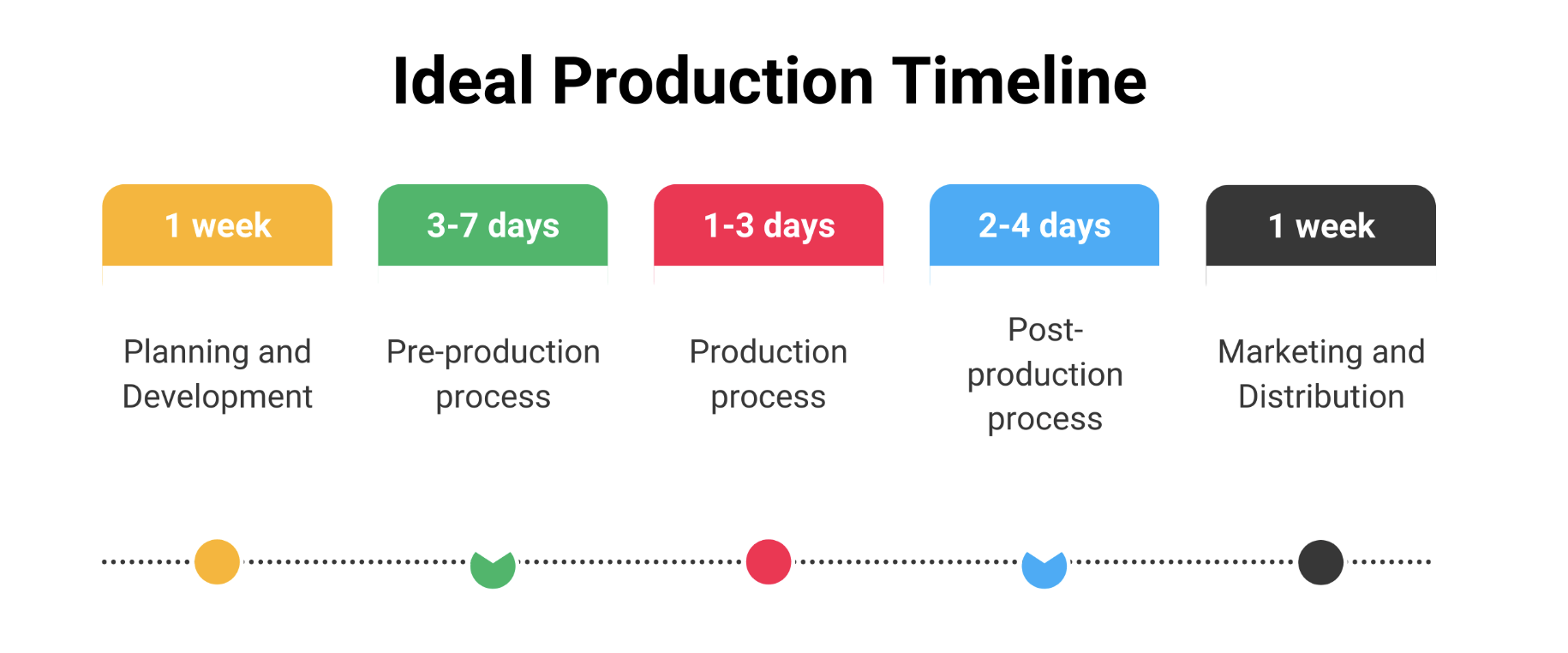
Video production is a relatively long process, and the timeline will highly depend on the video length and type.  In general, if we’re looking at producing a 3-minute video with a b-roll, interviews, and motion graphics, the process could take up to three to five weeks. Sounds quick, but definitely possible. 

How Long Does it Take to Produce A Video

Strategy Planning and Development (Est. 1 week)

Before you kickstart the video production process, you should first establish a plan. Next, understand what you want out of your video – your goals. After that, you can start liaising with a production company that can help you with the overall process.

But before setting up a meeting, answer these questions:

  • Who is your target audience?
  • What actions do you want them to take?
  • What is the message you want to get across?
  • What is your ideal budget?

Once you’ve narrowed these down, the production company will have a clear picture of your video project. Next, they need as much information as possible to develop a creative brief which includes project goals, scope and specs, timeline, video type (narrative or interview-based), talents needed, target locations, and a proposed budget for the project. This process can take about a week. 

Pre-production (3 to 7 days)

This step includes creative development and logistical planning, which typically takes up to a week, depending on the project’s scope; the simpler the content, the quicker the timeline.

To give you a better idea, let’s break this down:

  • Scriptwriting – Writing a script includes brainstorming concept ideas, research, the actual writing process, and getting approval. This usually takes up to 2-4 days of back-and-forth e-mails.
  • Storyboarding or shot listing – This happens just before a script is completed. A storyboard is a visual mock-up of the script, but not all script needs a storyboard; most of the time, video production companies would create a shot list instead of a storyboard. In general, this should just take a day.
  • Logistical Planning – This happens simultaneously with scriptwriting and storyboarding. From the planning stage, the production team should know everything needed for logistics: location hunt, hiring talents, equipment required, identifying crew members, and developing a shooting schedule. It is safe to say that four days is enough to do this process.

Production (1 to 3 days)

Once everything is set up, and your script is approved, you can finally shout, “Lights, Camera, Action!”. This phase is the actual filming stage which can take just half a day, especially if you nail the pre-production stage. But in the worst-case scenario, when the post-production team requests an additional shoot – it extends the video production timeline.

If your target location is overseas, we suggest ditching complicated travel and getting your video produced with local talents.

Read More: How to Produce Your International Media Project Without Traveling

Post Production (2 to 4 days)

After wrapping up the video shoot, the next step would be post-production – where the magic happens. Post-production includes processing footage, cutting, laying b-roll, mixing music, editing, adding graphics, color grading, and multiple video review rounds. Again, using a three-minute video as a baseline, two to four days is the safe bet, depending on the speed of the approving process.

Marketing and Distribution (1 week)

Before getting a go signal to launch a video, a promotional or marketing strategy should be mapped out. If you have a video production team, the best way to plan your marketing strategy is during the production and post-production phases, since you already have the good guys taking care of those processes.

Here are some tips to promote your video:

  1. Write a blog on your website
  2. Share it on social media
  3. Reach out to influencers who can promote your video
  4. E-mail marketing through newsletters
  5. Put some money and run a campaign ad
  6. Share it with online communities
  7. Play the video at an event

Producing a video is more than just pressing the record button on your camera. When you work with a renowned video production company and have a schedule to guide you, there is no doubt that the project will be done on time, on budget, and on message.

Tell Us About Your Project

Are you looking for the best video production company to collaborate with? We’re passionate about getting your story made. The planning, shooting, editing, and delivering of your video to help your business grow is on us. Tell us your vision, and our in-house creative team will get in touch with you.

Get a quote here


Film Abroad, Stay on Budget: Smart Planning For Global Projects

Film Abroad, Stay on Budget: Smart Planning For Global Projects

Producing brand content abroad opens up incredible opportunities to elevate your visual storytelling— new markets, authentic backdrops, and real stories waiting to be captured. But teams managing global campaigns, international shoots can also bring serious challenges: complex logistics, unexpected costs, and creative consistency across regions. With the right planning and trusted local partners, though, filming abroad can be both seamless and strategic— turning global complexity into content that truly resonates worldwide.

Quick Takeaways

  • Tap into local pros for permits, translation, and regional know-how.
  • Hire local crews to save on travel, lodging, and shipping costs.
  • Lock in transport and scouts early — it’s cheaper than last-minute changes.
  • Research permits, visas, and customs rules before you fly.
  • Consider an ATA Carnet or rent locally to avoid customs delays and excess baggage fees.

After managing productions around the world for over two decades, here’s what we’ve learned at Global Media Desk about staying creative, calm, and on budget when your shoot takes you overseas.

1. Start with a Realistic, Flexible Plan

A well-planned shoot is a cost-controlled shoot. Map out your shoot days, travel windows, and even buffer days for weather or local holidays that could affect scheduling. Get your production team together early to brainstorm every potential cost — from permits and crew meals to currency exchange fees — so there are no surprises later.

Pro tip: Build a “contingency cushion” of 10–15% into your budget. It’s much easier to adjust down than scramble for extra funding later.

2. Tap Into Local Expertise

No spreadsheet beats local knowledge. If you know someone who’s shot in your destination recently, reach out. Ask about hidden costs, transport challenges, and any unexpected hurdles they faced.

At Global Media Desk, we connect clients with trusted local crews and producers who’ve spent years filming in their region, so you get insight that only comes from working on the ground.

3. Hire Local Crews, It’s More Sustainable

Flying a crew overseas can eat half your budget before the first shutter click. Hiring vetted local talent saves on travel, lodging, and shipping heavy gear. Even better, they bring cultural fluency, language skills, and insider access that make your shoot run smoother and faster.

We only partner with crews who have 5+ years of verified experience working with international brands, so you can expect global standards with a local touch.

4. Consider Transportation Early

Travel logistics can make or break your budget. If you’re shooting in multiple or remote locations, hire a local driver or production vehicle for the duration of your shoot; they’ll know the shortcuts and the best times to move equipment.

Sometimes, sending a local location scout ahead of time to secure sites saves more than it costs. Wandering around post-arrival trying to “find the magic” usually adds time, fuel, and stress.

5. Know the Legal & Permit Landscape

Every country has its own rules. Some public spaces require special filming or photography permits, while others restrict the use of drones or lighting rigs. Do your homework early to avoid shutdowns or fines.

Check local authority websites or reach out to production partners for guidance on:

  • Filming permits and fees
  • Drone regulations
  • Visa or customs requirements

Useful tools:

Pro tip: If your project includes drone filming, plan even further ahead. Many countries have tightened regulations or heavily restricted commercial drone use due to privacy, safety, or military restrictions. Permit approval can take weeks or even months, and in some regions, foreign operators aren’t authorized to fly without a licensed local pilot. Always verify drone laws before you travel; it’ll save you time, paperwork, and the risk of having your gear confiscated at customs.

6. Manage Your Gear Like a Pro

Bringing your own gear? An ATA Carnet can save you from customs nightmares. It’s a travel document that lets you temporarily import and export professional equipment across borders without paying duties.

Still, it’s worth asking your local crew what’s already available on the ground — renting locally can eliminate excess baggage fees and reduce risk.

7. Partner with Experts Who’ve Done it Before

From permit research to local crew coordination, having a trusted partner on the ground can transform your production from stressful to seamless.

At Global Media Desk, we’ve helped hundreds of marketing teams, agencies, and production companies film and photograph in over 100 countries, keeping projects on time, on budget, and on brand.

Let’s make your next international shoot easier. Even if you’re just exploring options, our team is here to help. We’ll share what to expect and guide you through the logistics so you can plan every step with confidence—wherever your project takes you. Contact our team.

Master Multi-Location Video Production Without Losing Time, Budget, or Creative Consistency

Master Multi-Location Video Production Without Losing Time, Budget, or Creative Consistency

Managing video shoots across multiple locations is one of the toughest challenges for in-house producers and marketing teams. Between juggling time zones, budgets, and creative consistency, even the best-planned projects can hit major roadblocks. The good news? You don’t have to manage it all yourself.

By partnering with an international production agency, your team can streamline logistics, stay on budget, and maintain creative control—no matter how many cities or countries you’re shooting in.

TL;DR

  • The top 3 challenges are logistical coordination, budget limitations, and creative quality.
  • Collaborating with a global agency can be an amazing opportunity for companies looking to save costs and reduce their environmental impact.
  • These agencies have the expertise to handle multiple locations and keep production costs under control.
  • Adopting travel-free production practices, such as remote directing of video projects, is an eco-friendly and cost-effective solution.
  • They can also help ensure consistent and cohesive footage across all locations.

Here are the top three challenges you’re likely to face when working on multi-location video production projects and a few solutions you can employ to make your life easier:

    1. Logistical Coordination

Organizing a multi-location project can be complicated and stressful. You need to make sure that all the locations have the correct equipment, are coordinating specific talent and production staff, and, most importantly, that the script and creative vision are in line with your brand needs.

The solution? Partnering with an international video production agency can bring numerous benefits to your project. With their expertise in handling multiple locations, you can be assured that all necessary elements will be in place and all locations will meet your expectations. This means you won’t have to manage multiple schedules and locations alone, saving time and effort.

    1. Budget Limitations

Long-distance video production projects come with their own set of budget limitations. Travel costs, accommodations, and paying multiple teams in different locations can quickly add up and overshoot your budget.

Partnering with an international video production agency can be a fantastic way to keep your production costs under control and decrease your environmental impact. These agencies have connections all over the globe, so they can get you great deals with partners without the need to travel. By sourcing local staff, equipment, and resources in a geographically efficient manner, companies can execute their media projects with minimal global travel, which results in a smaller carbon footprint and lower project costs.

It’s also worth knowing that adopting travel-free production practices, such as remotely directing video projects, is an eco-friendly approach that can also help you save money. By working with the right global agency, you can contribute towards mitigating the effects of climate change.

    1. Creative Quality

For a multi-location video project, we understand that companies want to capture consistent and cohesive footage across all locations. Your creative team can play a crucial role in achieving this goal by providing a comprehensive creative brief.

To ensure that all the locations maintain the same creative quality, an international video production agency can provide you with remote crew members to make sure each location is in line with your creative goals. What’s more, they can provide experienced directors to each location to ensure your creative guidance and vision are adhered to.

If you’re struggling with the complexities of multi-location projects, creatively and logistically, don’t let that stop you from achieving your goals. With the help of an experienced international video production agency, like Global Media Desk, producing content across multiple locations can be a hassle-free and enjoyable process. Contact us today to learn how we can assist you with your multi-location projects.

The Importance of Balancing AI with Human Creativity in the Video Production Process

The Importance of Balancing AI with Human Creativity in the Video Production Process

Artificial intelligence (AI) is revolutionizing many industries, including video production. From automated editing tools to AI-powered cameras, technology has made it easier and faster to produce high-quality videos. However, as much as AI has simplified the video production process, it cannot replace human creativity.

We’ll explore why it’s essential to strike this balance and the many benefits it can bring to your video production projects.

TL;DR

  • With AI, time-consuming tasks such as video editing, color correction, and captioning can be done automatically and precisely.
  • AI can optimize certain parts of the video production process, but it lacks the ability to think creatively.
  • Human creativity is what separates good videos from great videos.
  • The lack of emotional understanding and cultural awareness of AI can lead to data and image generation biases, influencing how audiences perceive the brand.
  • Video producers can create compelling videos by combining AI and human creativity.

AI and Video Production

One of the main benefits of using AI in video production is its ability to streamline the process and save time and resources. With AI, time-consuming tasks such as video editing, color correction, and captioning can be done automatically and precisely. This allows video producers to focus on other creative aspects of their work, resulting in a more efficient and polished final product.

AI also offers the opportunity to create personalized and targeted content. Using data analysis and machine learning, AI can help video producers identify their target audience and tailor their videos to meet their needs and interests. This creates a more engaging and impactful experience for viewers, ultimately leading to better results for businesses and brands.

Beyond streamlining the production process, AI is also used in various video production applications. One such application is in motion graphics, where AI can analyze movement patterns and create seamless and visually stunning transitions and animations. Another feature, like AI-powered facial recognition technology, can be used to identify and track individuals in a video, making editing facial expressions and inserting text or graphics easier.

Another exciting application of AI in video production is virtual production. Producers can use AI-powered virtual cameras to create realistic and dynamic virtual environments for filming. This allows for more flexibility, faster turnaround times, and cost savings, especially for projects that require elaborate sets or locations that are difficult or expensive to access.

Limitations of AI in Video Production

While AI can optimize certain parts of the video production process, it lacks the ability to think creatively. It cannot match the human touch when it comes to storytelling, emotion, and aesthetics. While AI can create a basic narrative structure, it is unable to infuse a story with the nuances and complexities that make it engaging and memorable.

Another challenge is when creating content that is meant to be inclusive and culturally sensitive. The lack of emotional understanding and cultural awareness of AI can lead to biases in data and image generation, making it challenging to ensure that everyone feels represented. A recent article by The Atlantic, “AI Has a Hotness Problem,” found that AI-generated imagery tends to render, at an alarming rate, gorgeous people or wrinkled, unproportioned faces.

By incorporating human input and oversight, your video assets can limit these biases and create content that is welcoming to all audiences.

The Importance of Human Creativity in Video Production

In video production, human ingenuity is vital – the driving force behind the imaginative choices that make videos engaging, memorable, and impactful.

Our human expressiveness is essential in the pre-production phase of video production. This is where the creative team develops the video’s concept, story, and visual style. It is also where the team decides on the tone and messaging of the video, which can influence how audiences perceive the brand.

Human creativity is equally important in the post-production phase, where the final product is assembled. This is where the editor makes creative decisions on pacing, timing, and transitions, which can significantly impact the emotional impact of the video.

The Benefits of Balancing AI with Human Creativity

Although AI can automate parts of video production, it can’t replace human creativity and intuition. When balanced, they can create remarkable results. Here are five benefits:

  1. Increased Efficiency
  2. AI can help automate repetitive tasks, allowing human creatives to focus on more complex aspects of video production. This can help to increase efficiency and reduce production time.

  3. Enhanced Creativity
  4. When AI is used to optimize certain aspects of video production, human creatives can focus on more creative aspects of the process. This can lead to more innovative and engaging videos.

  5. Improved Quality
  6. When AI analyzes data on audience preferences and behavior, human creatives can use this information to create more relevant and impactful videos.

  7. Human Connection
  8. Human creativity is what creates an emotional connection between the video and the audience. While AI can create a basic narrative structure, it cannot infuse a story with the nuances and complexities that make it engaging and memorable.

  9. Flexibility
  10. When AI is balanced with human ingenuity, the creative team can be more flexible and adaptable to changes in the project, leading to a final product that better caters to the needs and expectations of the targeted audience.

By leveraging the strengths of both AI and human ingenuity, video production teams can create videos that connect with audiences and achieve the desired results.

Why Choose Global Media Desk for Your Next Video Campaign?

Global Media Desk is a video production company with more than 23 years of experience. We work with various brands and industries, creating exceptional video content that is customized to meet their specific needs and goals.

We have a trusted and experienced network of production crews across the world, skilled in the latest technologies and automated workflows. You can rest assured that your videos will be exceptional, effective, and budget-friendly. With professional producers and crews, everything is handled virtually, so there’s no need to travel. Get in contact with us today.

Corporate Video Production Made Easy: 7 Reasons Global Media Desk Is Your Secret Weapon

Corporate Video Production Made Easy: 7 Reasons Global Media Desk Is Your Secret Weapon

Are you currently in the process of creating a compelling video for your brand in an unfamiliar city? Managing budget constraints, language barriers, and unfamiliar territories while striving to maintain a work-life balance can be pretty challenging. But fear not! We have an excellent solution to transform this daunting task into a seamless triumph. Instead of spending countless hours on travel logistics and splurging on expensive production crews, why not enlist Global Media Desk, a global media production company with established local connections, to take charge? Rest assured, this approach will position you as the hero of your brand’s next great narrative.

Let’s break down the benefits of choosing Global Media Desk for your upcoming video project abroad or in a neighboring city.

1. Cost Savings

Every penny counts when producing a video. Using a global media production company with local talent, like Global Media Desk, can save thousands of dollars on travel expenses, visas, permits, and accommodations. Additionally, Global Media Desk has in-depth knowledge and experience in key market areas, allowing us to negotiate better prices with local providers.

2. Professional and Pre-Vetted Networks

It can be risky to hire a production crew from an unfamiliar city without knowledge of their skills and abilities. By working with Global Media Desk, you can have peace of mind knowing that we have already vetted our network of professionals. We have established relationships with experienced videographers, film crews, directors, actors, and sound engineers who can bring your vision to life.

3. Prep-Production – Custom Tailored Planning

The preparation phase of any video project is crucial – it’s the bedrock of the entire production. An experienced global production agency thrives in this stage, providing meticulous pre-production planning and coordination. Here at Global Media Desk, we roll up our sleeves and work closely with your team to fully understand your goals, target audience, and brand message. This ensures that every aspect of the video script and other pre-production details aligns perfectly with your brand objectives.

4. Stress-Free Logistics

When producing a video in an unfamiliar city or location, there are countless logistical details to consider, such as transportation, accommodations, equipment rentals, and permits. Global Media Desk will handle all of this for you, removing the stress and headache from your shoulders. We have the local knowledge and connections to ensure a smooth and successful production.

5. Lower Environmental Impact

With the increasing concerns about climate change, many companies are looking for ways to reduce their carbon footprint. By using Global Media Desk, you can significantly decrease the environmental impact of your video production. A shorter travel distance means fewer emissions from transportation, and you can also support the local economy by hiring local crews and using locally sourced materials.

6. Post-Production – Professional Editing, Quality Control and Revisions

After the cameras stop rolling, the real magic happens in post-production. Global Media Desk offers significant advantages during this stage, turning raw footage into a compelling narrative that connects with your audience.

Our talented video editors expertly blend creativity and precision while seamlessly weaving in graphics, animations, and music to elevate the storytelling experience. Our quality control processes ensure that the final output exceeds your expectations. Plus, with our flexible revision options, you can tweak every detail until it’s perfect.

7. More Time for Work and Play

As marketing professionals or producers, your plate is already full of various tasks and responsibilities. Imagine being able to delegate logistics, filming, on-the-ground operations, and editing to the experts at Global Media Desk. By doing so, you could free up time to focus on your strengths, such as developing killer marketing campaigns or fine-tuning strategies to outperform the competition. In addition to enhancing your professional capabilities, you’ll also gain extra time. You could use this time for personal growth and professional development, or better yet, take a well-deserved break.

Choosing a global media production company for your video projects, whether abroad or in a neighboring city, isn’t just a smart move—it’s practically genius. This choice can lead to cost savings, a reduced environmental impact, and give you more time for yourself and your work. It’s the trifecta: you win, your team wins, and Mother Earth wins.

So, next time you’re tasked with a video production project, give Global Media Desk a go, and see the remarkable difference it makes. Happy filming!

Shameless Plug

Global Media Desk is a video production company with more than 23 years of experience. We work with various brands and industries, creating exceptional video content that is customized to meet their specific needs and goals. We have a trusted and experienced network of production crews across the world, skilled in the latest technologies and automated workflows. You can rest assured that your videos will be exceptional, effective, and budget-friendly. Get in contact with us today.

Global Video Marketing Made Easy: How to Maximize Your Brand’s Video Investment

Global Video Marketing Made Easy: How to Maximize Your Brand’s Video Investment

Feeling stretched thin but still expected to crank out more content? In 2025, video isn’t just another task on your list, it’s your brand’s passport to global visibility. With over 80% of internet traffic predicted to be video this year, companies that win attention (and sales) are the ones consistently creating high-quality video content that resonates in every market they serve.

At Global Media Desk, we help brands brainstorm, shoot anywhere in the world with vetted local crews, then turn that footage into powerful, multi-use content through our in-house video editing team. Whether you’re filming in Tokyo, São Paulo, Berlin, or Los Angeles, we make it seamless and cost-effective.

1. Win Viewers in Three Seconds (or Less)

You’ve got the attention span of a goldfish to work with: 82% of viewers decide whether to keep watching within the first three seconds.
This means:

  • leading with your strongest visual or headline;
  • tailoring short-form (under 1-minute) content for social; and
  • saving longer formats for landing pages, product demos, or brand storytelling.

Pro Tip: Our in-house producers plan storyboards with your regional goals in mind so you get maximum impact from every second of footage.

2. Think Beyond the Shoot — Repurpose with Purpose

One shoot can fuel an entire campaign if you plan it right. From a single day on location, you can create:

  • short-form clips for social media;
  • behind-the-scenes reels for Instagram Stories;
  • subtitled email teasers; and
  • ads optimized for YouTube, Instagram, or region-specific channels.

With our in-house editors, we repurpose your footage for every market, so one shoot fuels an entire campaign without breaking your budget.

Pro Tip: Flying crews around the world? That’s expensive. Hiring local crews you can trust? That’s our specialty.

3. Be Found Everywhere with Video SEO

Even the best videos won’t perform if no one can find them. Whether your target is a B2B buyer in New York or a lifestyle customer in Amsterdam, video SEO ensures you’re visible in search, including AI-powered search results.

  • Boost discoverability by:
  • crafting keyword-rich titles and descriptions;
  • creating eye-catching thumbnails; and
  • adding captions for accessibility and search ranking.

Result? Videos that rank, get shared, and stay relevant longer. Well-optimized videos outperform unoptimized ones by over 2x in organic reach.

4. Balance Organic Reach and Paid

Organic video builds trust, but geo-targeted paid ads put you in front of the right audience at the right time.
Consider testing:

  • YouTube pre-roll ads for awareness;
  • Google Video Action campaigns for localized conversions; and
  • Meta ads that retarget warm audiences.

And always, always check your analytics, because you want your budget to go to what’s actually working.

5. Quality Wins—AI Helps, but Humans Seal the Deal

AI editing tools like Canva and Clipchamp are great for speed, but nothing replaces human creativity and precision when your brand is on the line.

That’s where our editing team steps in, combining efficiency tools with skilled editors who know how to keep your brand’s look, feel, and message stay consistent across all content at an affordable price.

Bottom Line

Video marketing isn’t slowing down—it’s just getting more competitive. The brands that will win in 2026 are the ones investing in high-quality content, smart distribution, and cost-effective editing solutions.

With Global Media Desk, you can film anywhere in the world, get a library of content from one shoot, and have it polished by our in-house editing pros, all without blowing your budget.

Ready to get more from your video investment? Let’s plan your next shoot.

Maximize Your Brand’s Video Production Potential: 6 Benefits of Outsourcing Your Pre & Post Production

Maximize Your Brand’s Video Production Potential: 6 Benefits of Outsourcing Your Pre & Post Production

We all know that in today’s digital arena, captivating video content is the golden ticket to your audience’s heart. But let’s face it, producing engaging videos isn’t always a walk in the park. The endless hours, the high-tech equipment, the ever-evolving trends – it can feel like taming a wild beast!

That’s where we come in. At Global Media Desk, we’ve walked the same path and understand the challenges you face. With our seasoned expertise, we offer a game-changing solution – try outsourcing your video pre- and post-production. Trust us, this is a strategy that will not only save you time and money but will inject your brand’s videos with pizzazz and professionalism.

Here are six reasons why outsourcing is your smartest move in the video production playbook.

1. Access to Expertise & Talent 

If you have worked with us before, you know that we assign and deliver local talent globally. From small-scale videographers to full-blown commercial shoots, our crews deliver top-quality footage every time. And guess what? We also bring specialized script writers and video editors to take your content to the next level. Our vetted experts have the necessary skills, knowledge, and experience to transform raw footage into high-quality, polished videos.

2. Scalability and Flexibility

Outsourcing allows brands to scale their video production efforts up or down based on their needs without the long-term commitment of maintaining a large in-house team. This flexibility is particularly beneficial for projects with varying demands or tight deadlines.

3. Fresh Perspectives

Hiring external production teams can bring a breath of fresh air to your brand’s content, sparking creativity and engagement in video scripts and marketing strategies. This innovative approach can better tailor the content to current market trends and audience preferences.

4. Efficient Project Management

Outsourcing to a production team often includes project management services, ensuring that deadlines are met and that the scripting and editing process is streamlined. This structured approach minimizes the risk of delays and ensures consistent quality throughout the project.

5. Time Savings

An external production partner can handle multiple tasks simultaneously, ensuring efficient and timely project completion. This allows you to focus on your business and core strategies confidently.

6. Cost Efficiency

High-quality video production requires specialized equipment that can be extremely costly to buy and maintain. By outsourcing, brands can access cutting-edge technology without the hefty price tag of purchasing and constantly upgrading equipment.

By contracting out pre-production and video editing, brands can tap into professional expertise and cutting-edge technology. The result? Captivating video content that engages audiences and elevates brand messaging to new heights.

Give Global Media Desk a Try

Global Media Desk is a video production company with over 23 years of experience. We work with various brands and industries, creating exceptional video content customized to meet their specific needs and goals. We have a trusted and experienced network of production crews across the world, skilled in the latest equipment and automated workflows. You can rest assured that your videos will be exceptional, effective, and budget-friendly. Get in contact with us today.